In this edition of The Glimmerists I am going write about my history of drawing. Generally I keep the drawing work and the ceramic artworks separate, I even have different Social Media streams for them. Most of the time this makes sense, the division is between two audiences, not many people follow both accounts but I am going to tackle this graphic aspect of my work because it is related to my ceramic artworks in that most artists draw to some extent and that includes me.
Giving form
Drawing was the first evidence when I was a child of my interest in making things, in taking things from my mind and transferring them onto materials, of giving them form. I am talking about early years, aged four or five maybe, the clay work came a bit later with the introduction of plasticine. My mother was a primary school teacher so I think the materials were probably straight-forward to get.
The significant advantage
My relationship to drawing has changed a lot over the years. Drawing was a skill where I had a significant advantage over my older brother. It was very important for me because in most things I was less advanced than him. At junior school I thrived in the art class. When I moved to secondary school the art teacher had his own agenda which did not involve much individual choice so when I reached adolescence it did not work and for a couple of years I even gave up art at school and started painting and making sculpture at home. Later I was sent to life drawing classes at the local art school which felt like a step up into adulthood. When I left secondary school behind and went on my Art foundation year (aged 16) there was a clear shift away from drawing and towards photography almost as if they were inter-changeable. I didn’t stop drawing as a way of working out ideas and have always maintained a sketchbook but for most of my adult life my practice of any other drawing has been intermittent. My practice of photography on the other hand has been much more consistent.
 Drawing is Free
I did quite a lot of spontaneous drawings for a five year period about 15 years ago then I did a drawing-a-day project (30/30 a scheme run by 12ø Collective and supported by Artquest) in 2021 and that eventually led me to trying DrawingisFree.
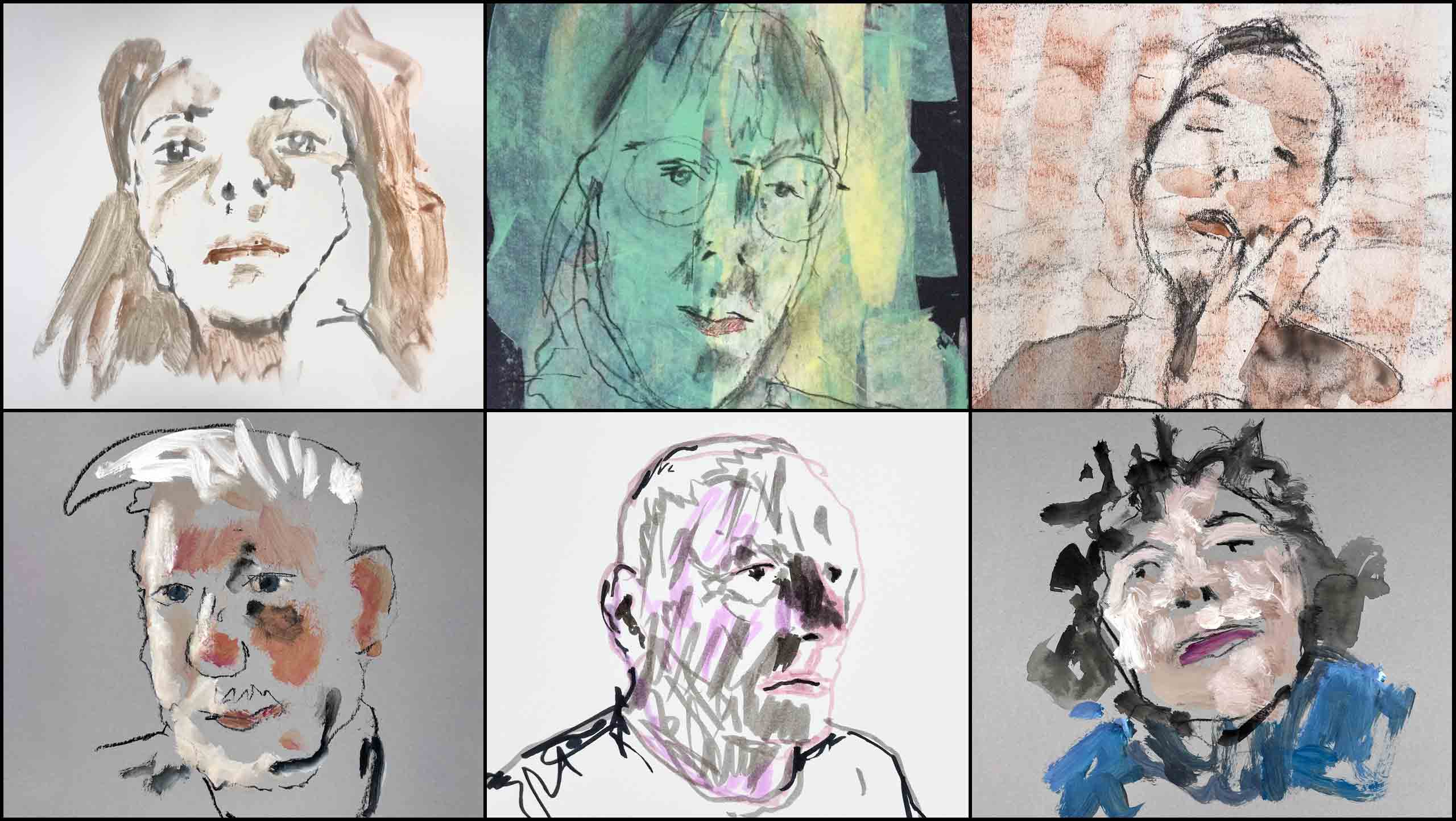
I have attended almost every Monday morning 1 hour session of #DrawingisFree for five years. I am not sure I am not addicted to it, it’s such a celebration of collective concentration. Hundreds of people from all over the globe spend an hour trying to depict each other on paper at great speed. This was one of the groups that moved onto Zoom when the Covid lockdowns happened, it has been so successful that it still continues and continues to grow.
I have very mixed results, many of my attempts are not good, others seem full of energy and occasional accuracy and some captured likeness. I find that one or two drawings from each session are good enough to be worth storing (but I often keep more in the hope they will mature with age!)
Production and storage
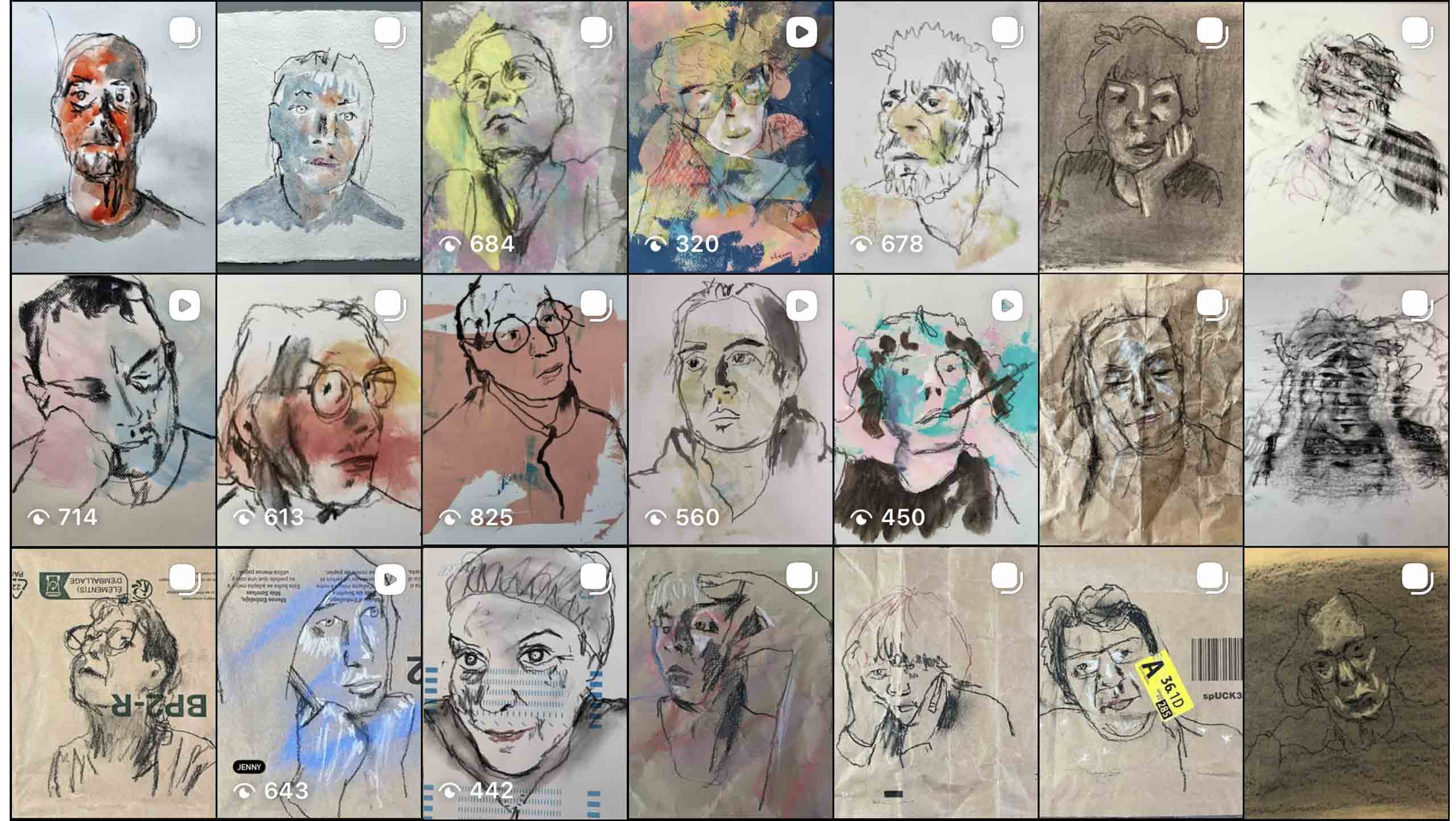
Then there is the amazing productivity. In the hour we make 12-15 drawings. I usually make each drawing fill an A4 sheet of paper, recently I started working at A3 again. But I can’t sustain that – I do not have the storage space. I am constantly editing my collection of fast portrait drawings and discarding the less successful ones to make room for new ones. It’s very hard to keep up. The physical space is a naturally limiting factor on how much any of us can store.
There’s also another kind of storage going on. Digital storage of photographs and videos of our drawings both on our own devices and on Instagram’s servers. There is quite a lot of arcane information if you search for it that attempts to quantify how much data is involved and how much electricity it all consumes. It’s not just the posting and storing of the images but each time an image or video is viewed it takes power to call it up from the server and send it to the viewers screen. (I think the ecology of this might be the subject for a further post)
Drawing serendipity
For me this raises a lot of questions about why we are doing this? I really enjoy doing the hour each Monday morning. It’s productive, creative and always challenging. I often change the materials I use to vary my results and to keep the standard of difficulty at just the right level so I can make some decent drawings, some really good drawings and lots of brave attempts. That’s seems to be how it works. If all my drawings were brilliant, if the results were predictable I suspect it would be less consuming because that would mean I was working to some kind of formula.
I think the unpredictability, the serendipitous nature of drawing is one of the things that makes it rather magical. On consideration I think there’s a similar quality in taking photographs, we always want to see how it comes out, we are all rather fascinated by how the process works, or even amazed that it does work, we are always interested enough to want to see the proof each time. You just don’t know if it will really work until you see it – each time. Integral to this is wanting to see how we are represented, how we are seen, how we all see each other too. Mirrors are not enough – we also use drawings, photos and video to check how we appear and how we compare to everyone else.
Drawing to prove you can
And then there’s being an artist. When I was growing up an artist was someone who could draw. It was a universal truth which I later discovered was being eaten away throughout the twentieth century in the thinking of artists but which still persists in most peoples minds today. To my mind it’s still hard not to see the ability to draw from life as a kind of acid test of your right to call yourself an artist.
Drawing for the present
Drawing is such a great way to focus on the present. You have to just be as bold and as brave as you can to place your marks on the page. Each mark risks ruining or making the drawing you are engaged with. You have to be committed to what you are doing in each moment. In this you are guided by your eyes, your brain and your body – mainly fingers and hands but also everything that supports them including your breath and general health.
It takes a lot of concentration. You have to mentally measure where everything should go on the page. How far is the ear from the eye? How does the line of the jaw relate to the mouth and the nose? How will I render the hair? How does this head relate to the rest of the body? Is there any chance that my marks will resemble the model even slightly apart from the fact there are two eyes one nose and one mouth? If you had time to stop and answer these questions the moment would be lost. There is no time, the only answers are your marks on the page and they are either right or wrong, you really have to trust your judgements and impulses.
Drawing together
Drawing in the company of hundreds of others feels like a really important factor in this way of working. The fact that a whole gathering of artists is seeing exactly what you are seeing at the same moment as you but interpreting it each in their own very diverse ways with their own materials is part of the process that is hard to define but is something you are aware of as you work. It’s just there. I suspect it’s one of the things that magnifies the energy of each of us and of the whole group and increases the focus and the jeopardy of daring to make a likeness.
 There must be a strong element of competition in this mix too. That seems always to be present in some form in an art room, either a real room or a virtual one through the Zoom app. This element is also present but hard to pinpoint. If I think about it the whole thing feels like a tightrope walk with different forces that support you and work against you that you have to process as you draw as well as all the issues that crop up on the surface of the paper. As you draw you come upon your own judgements, echoes of other peoples past criticisms and remarks that you have taken on. In this way drawing represents a way to get to know yourself and your internal voices and an opportunity to change those patterns when you are ready.
Held by the structure
I find I am very held by the very clear and consistent structure of this weekly exercise. I know what to do, portrait drawing is guided by aiming for a likeness. I know what my choices are and what I have no control over and I accept all this as a way of working for one hour of my life, once a week, most weeks.
Drawing is true
The overall aim for me in this exercise is to make something that has a ring of truth about it. Making a likeness is an almost measurable part of this activity although that’s only part of it. Making a drawing that contains commitment and energy is another. The speed of the work forces bravery and decisiveness so it’s not surprising that the results are mixed – the process creates unpredictability which has positive and negative effects on the resulting drawings.
Authenticity & nourishment
I think I am aiming for a similar sense of authenticity in my ceramic work. The artworks I really value have something universal and clear, something that transcends the need for attention we all have, something that they give to the viewer. The artist has to dig deep to achieve this. To my mind a successful work of art gives you energy and nourishment – so the attention you pay it is given back and even amplified. If a work does that then you should feel it. Making that happen is hard and unpredictable – the drawing process is almost unknowable because it’s so complex and multi-layered, occurring on physical, mental and emotional levels all at once – no wonder it’s such a hit and miss process and no wonder it is so completely engaging.
About The Glimmerists
This article is based on one published a week ago in my email newsletter The Glimmerists. If you subscribe you get the article before the version is published here on the website. There is more in the newsletter too including a feature artwork piece in each issue with insights about how artworks are made and how the ideas behind them evolve.
You can also get a discount code for a set of limited edition prints of my work when you subscribe.